
Securing your FFP2 supply for winter: prices are rising and there is no federal reserve
Infections are rising, protective clothing is getting more expensive and no funds are planned for Germany’s national health protection reserve in 2027 either. How facilities can calculate their needs and cover them before the flu wave.
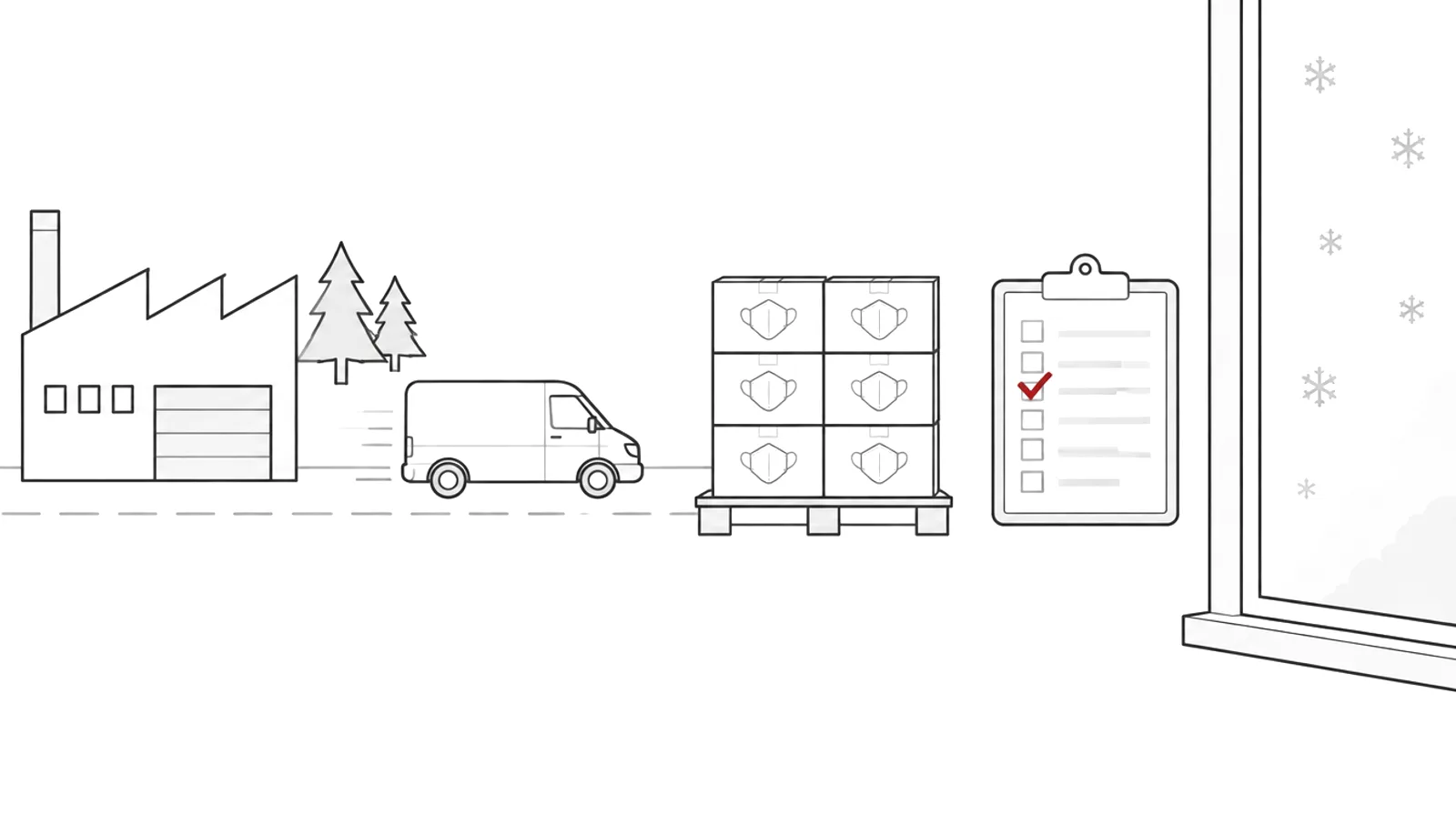
Respiratory infections are increasing, protective clothing is getting more expensive and there is no state reserve. If you plan now, you will have enough masks in stock when the flu wave arrives and will not have to restock under time pressure. Here is the current situation and how to calculate your needs.
Infections are rising, and most outbreaks occur in hospitals and care homes
According to the weekly report of the Robert Koch Institute (RKI), Germany’s public health institute, for the week of 2 to 8 November, acute respiratory illnesses in the population are at a moderate and rising level. The number of doctor visits remained stable. Reported COVID-19 cases have almost tripled since the start of the season in late September, and influenza cases are increasing too. What stands out is where outbreaks occur:
- COVID-19 cases per week
- from 596 to 1,618 within five weeks
- COVID-19 outbreaks since the start of the season
- 49, of which 30 in hospitals
- In care homes for the elderly
- 12 more
- Influenza outbreaks
- 9, of which 8 in hospitals and care homes
COVID-19 figures are still well below last year, and the RKI has not yet declared a flu wave. Last season, it began at the end of November. The coming weeks are therefore the time to prepare.
Supply chains under pressure, protective clothing getting more expensive
In April, the German Hospital Federation (DKG) warned of shortages of disposable gloves and protective equipment. Many manufacturers in East Asia had stopped taking orders because, as a result of the war in Iran, they lacked petroleum-based raw materials such as naphtha and ethylene. Stocks held by hospitals and retailers are still providing a buffer. If the crisis continues, however, hospital buyers must expect sharp price jumps or empty warehouses, according to the DKG.
According to the price index of the Praxisdienst platform, medical consumables were almost 7% more expensive in the third quarter of 2026 than a year earlier. Protective clothing rose the most, by 3.6% compared with the previous quarter. Praxisdienst expects further increases in the fourth quarter.
The state reserve remains empty
In June 2020, the German government decided to set up a national health protection reserve. Through stockpiles and secured production capacity, it was meant to cover the needs of the health sector for up to six months. In the government’s draft 2027 federal budget, the budget line for it is empty, as it was in 2025 and 2026. The budget committee did increase the health budget on 13 November, mainly for the health fund. Reports on the session do not mention any money for the reserve.
Little is left from the federal government’s COVID-19 procurement either: according to the government, only around 5 million FFP2 masks were still available for distribution in early 2026.
A planned health security act is meant to strengthen crisis preparedness. When presenting the key points in early November, the Federal Ministry of Health announced stricter stockpiling requirements, for example for pharmacies and wholesalers. No requirements for protective equipment in hospitals, care homes or practices have been announced so far. The German Medical Association is calling for the reserve to finally be set up with at least six months of stock. Until then, preparedness is up to each facility.
How to calculate your needs
An FFP2 mask marked NR is a single-use mask. Replace it after one shift at the latest, or sooner if it becomes damp or breathing gets harder. The basic calculation is: staff who need masks × shifts per week × masks per shift × weeks of stock. Add masks for visitors and for patients with symptoms.
- Example: staff on one ward
- 20
- Shifts per person and week
- 5
- Masks per shift
- 1 to 2
- Needs for 6 weeks
- 600 to 1,200 masks
That is one to two master cartons of 675 masks each, currently €329.95 per master carton in our shop. Even with two masks per shift, six weeks of stock for this ward costs less than €660. Set how many weeks your stock should cover in your hygiene or pandemic plan. Base it on demand during an infection wave.
Building stock without masks expiring
- Set your coverage: how many weeks your stock should last when demand is high
- Set a reorder point: at this stock level you reorder, so the delivery time is covered
- First to expire, first out: the PREMIUM FFP2 YOU-M4 has a shelf life of two years from manufacture
- Agree quantities and delivery dates for the winter with your supplier now
Check the marking when you reorder
It is worth checking the marking when you reorder, too. In September 2026, German authorities reported an FFP2 mask made in China via the EU’s Safety Gate alert system, and the importer recalled it. Its filtration efficiency was as low as 42%. The EN 149 standard requires at least 94% for FFP2.
Look in the data sheet and on delivery for the CE mark with the four-digit number of the notified body that monitors production. The number can be looked up in the EU’s NANDO database. For the YOU-M4 it is CE 0158, the number of DEKRA.
Framework agreements and fixed delivery dates for facilities
Your winter stock from Bad Dürrheim
We manufacture the PREMIUM FFP2 YOU-M4 in Bad Dürrheim from materials made in Germany, and DEKRA monitors production. Tell us your number of staff, shifts and the weeks of stock you want, and we will prepare a quote with fixed delivery dates. Order smaller quantities directly in our shop, with free delivery within Germany from €100.
Sources: RKI, weekly ARE report week 45/2026 (data as of 10.11.2026); Federal Ministry of Health, report on the national health protection reserve (July 2021); German Hospital Federation, press release of 08.04.2026; Praxisdienst price index Q3 2026 (zm-online, 05.10.2026); government draft federal budget 2027, section 15; German Bundestag, final budget committee session (13.11.2026); federal government answer to a parliamentary question on COVID-19 protective masks (dpa, 05.02.2026); KBV, key points of the health security act (05.11.2026); German Medical Association, strategy paper of 02.09.2026; EU Safety Gate (September 2026).